Sunday, November 14, 2010

mirrors responding

After we were learnt practitioners (more will come in later blogs) Andy told us that we have to create a piece using one of the practitioners to create a piece of drama. Our stimuli for this was the word Mirror.

We were first set the task to write down our responses to the word Mirror, words, songs, feelings etc.

  • One of the first things I thought of were fairytales, with reference to snow white. 'Mirror Mirror on the wall, who's the fairest of them all' being the catch phrase with the bad guy throughout that particular fairytale. The idea of good verses evil could be shown throughout the performance. You could perform about a bad person wanting to put on a mask to show that actually he/she is a good person. Using conventions such as thought track and freeze frame to change the character. Going into the fantasy land would be essential. You could go into a performance of mime using abstract mime, like in Alice in Wonderland. Where there is no storyline, but you go into the characters thoughts and feelings and the portrayal of the character. This could also be shown through Commedia, having a complete spin, and almost turning it into a Pantomime, using exaggerated movements and the Pantilone walk could show the evilness of the character saying these lines.
  • Shows the inside of yourself, the person who you are compared to the image you put on.


  • Reflection..
- where... in water? in the mirror? in yourself? in others?
- so many questions.
- This photo (Taken by Sian Drew of Beccy Drew) could represent black and white culture, and how someone's personality is 'black and white' yet they are trying to break through becoming themselves as human beings. You could portray this through a mime, having two people play the same person. It could be an abstract mime, just showing clear viewpoints of how each part of that person is feeling. It could also be very improvised, and having contact improvisation to show that they are one person working in view points, but its completely different characteristics. This could show mutuality. For example, the black and white person could be quite sad and depressed and the happy person be very happy and full of life. This person is also reflecting themselves through a mirror.
- who are you reflecting to? and why? could be to the audience, or to yourself? are you reflecting your true colours? why are you reflecting? do you need to? do you need to make a decision?
- the person you become, is it a reflection. are you inside yourself
- what do you see in the reflection? anger, hunger, the angel/devil. conscience. influencing decisions in life?
- You could have a storyline of butoh, having the angel and devil influencing you constantly and you don't know where you are going.

  • Eating disorders
  • Disorders in general

  • Man in the mirror - Michael Jackson
The chorus:
'I'm starting with the Man in the Mirror
I'm asking him to change his ways
And no message, could have been any clearer
if you wanna make the world a better place take a look at yourself and make that change'
I feel these lyrics say a lot about mirrors, and how people look inside themselves. This song could be a great backing track to a piece of mime about mirrors. as seen in video. (http://abbiphysicaltheatre.blogspot.com/2010/11/video.html). You can really use the lyrics to create a mime from 'Message' 'Clearer' 'World'. Creating a clear picture to the audience of the storyline.

  • Paparazzi
  • Depression
  • Erised - to get what you need, not what you want.
  • Twins

This is one of many photo's I could have chosen to represent 'Twins' (taken by Rebecca Brown: http://www.flickr.com/photos/beckie0/)

This could mean anything, it could represent the idea of how two people could not want to be a like any more, and they have completely different personalities. This could be shown by mime, and in parts the actors are mirroring each other, yet at other parts they are reaching out, doing completely different things to show that they are still individual, even though they look the same. They could be arguing with each other. also, contact improvisation could be used as twins know each other very well therefore they could use it affectively.


  • “Every beautiful girl sees a monster in the mirror.”
I felt that this was a really really beautiful photo (unknown photographer). It says a lot about how mirrors can have an affect on people. With the quote, I believe that EVERY girl sees a monster in the mirror. I also thought the hand being on the mouth although lipstick is being put on, its quite significant and I would like to put it into the performance. I also like the idea of it being out in the public, as the setting is public toilets I believe.
You could go into a Butoh performance using this picture by having the monster become you as the storyline. You are trying not to become the monster but in the end the monster wins. You could use a mixture of solid, sharp movements and flowy movements to get this idea across to the audience.

Video


This mime I felt was really clever.
- The costume was great, it really worked with the piece as its black and white, hiding the true mime person. Obviously the person of mime, but the mask hiding the person was significant. And breaking into the mirror and becoming someone else also showed the confusion of personality, happening a lot in teenage girls. Using normal things that happen in life (reading the newspaper) to get the idea of normality across would be something to consider putting into the performance. I feel that I would only want the chorus of the song though to have Michael Jackson singing, the rest to be the background, because it could distract from the performance.

Tuesday, November 9, 2010

Simalarities and Differences between Jacque Lecoq and Commedia Dell'Larte

Similarities
  •  They both use masks
  •  Exaggerated movement is necessary.
  • The work is a lot improvised.
Differences
  • Jacque lecoq uses this technique as a training method. Whereas Commedia is a performance..
  • Jacque Lecoq uses masks to create neutrality, therefore they have no personality. Their personalities are not already known. There is also hardly any speech used. Jacque Lecoq uses masks to create characters with already known characteristics and personality.
  • Jacque Lecoq uses facial expressions for their character masks and not their neutral masks.
  • Commedia Dell'Larte uses the facial expressions to create teh characters.
  • Commedia Dell'Larte masks are used to create the already known stock characters.

Jacque Lecoq

Background
The theatre practisioner Jacque Lecoq was born in Paris, December 15, 1921.
He was most famous for his method on physical theatre, movement and mime taught at l'École Internationale de Théâtre Jacques Lecoq since 1956.  He founded the school.
He first began to learn the art of Commedia Dell'Larte as he lived in Italy for 8 years. Whilst in Italy, he met up with a sculptor Amleto Sartori to which then they created the neutral mask.
When he came back to France, he opened a school of mime. He did also do some television work, but his school was such a big success he focused all his time on teaching. During when he was alive, he developed a teaching programme, and he also founded the stage design department of the school, making the name l'École Internationale de Théâtre Jacques Lecoq. Jacque Lecoq died in January 19th 1999 but he was known to have been teaching a few days before. His wife now continues his successfull school and continues to teach students his techniques.
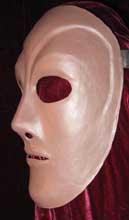
His main focus is to create the neutral mask, using techniques, his students learn to become neautral, adopt neutral features. This is to help the students become neutral, so then they can adopt other styles.

What did we do in the lesson to understand Jacque Lecoq
We were given a mask to help others become neutral. We were told to make our facial expressions fill the mask, to help us with the neuteal character we were becoming. Personally, this part was difficult because I had a full mask on, other did have half masks therefore they were able to complete this. Then, we had to let the mask become ourselves, by picking out an object we coudl create a character. We watched others perform and performed ourselves with the object. We then took the masks off and then explained how we felt. I felt really exhilarated from it. Then we went into partners, and one of the partners put on the mask whilst the other looked after them. The person wearing the mask let themselves go in a sense. Then, we had to think of a word that the character we have on the spot, and one that suited our character. My character's 'chosen' word was 'hair'. Joe was asking questions then I had to reply with the word hair. I felt this lesson I totally became out myself, and although this happened. I throughorly enjoyed the lesson because it made me think about how I act and how it signifies me, aswell as others characteristics signify them.

Friday, October 29, 2010

Similarities and Differences between Greek Theatre and Commedia Dell'Larte

Simalarities
- They both use exaggerated movements to create comedy to the audience
- Comedy is the key element or one of the key elements
- They both have a need of grabbing the audience's attention.

Differences
- performed at different places and different times
- Chorus is used in greek theatre and Commedia Dell'Larte uses stock characters
- Chorus in Greek Theatre used as narrator.

Thursday, October 28, 2010

Commedia Dell'Arte

Background

Commedia Dell'Arte is italian comedy. Ironically it means Comedy of Proffession or Comedy of Art. It also stands for improvised or unwritten drama. It is still used today, with many actors specialising in it. It was around for probably 400 years but was most well known in the sixteenth and seventeenth centuary. Performers played in temporary stages, such as city streets or court venues. Better troupes such as Gelosi, Confidenti performed in palaces. They also became internationally famous once they travelled abroad. They used dance, music and witty dialogue to create the comedy effect. When performed abroad, the language didn't change to the country's language, as some of the characters already used dilect of the country.

Performing in the streets was an advantage for Commedia, as it removes the 'fourth wall' and relates to the audience much more. This is also significant as the characters relate to the audience a lot.

Characters:
 'Regardless of region, il Capitano would have spoken in Spanish, il Dottore in Bolognese, and l'Arlecchino in utter gibberish.' il Capitano, il Dottore and l'Arlecchino are stock characters. The focus is on the physicality rather than the spoken words.


  • 'Arlecchino was the most famous. He was an acrobat and a wit, childlike and amorous. He wore a cat–like mask and motley colored clothes and carried a bat or wooden sword.


  • Brighella, Arlecchino's crony, was more roguish and sophisticated, a cowardly villain who would do anything for money.


  • Il Capitano (the captain) was a caricature of the professional soldier—bold, swaggering, and cowardly.


  • Il Dottore (the doctor) was a caricature of learning—pompous and fraudulent.


  • Pantalone was a caricature of the Venetian merchant, rich and retired, mean and miserly, with a young wife or an adventurous daughter.


  • Pedrolino was a white–faced, moon–struck dreamer and the forerunner of today's clown.


  • Pulcinella, as seen in the English Punch and Judy shows, was a dwarfish humpback with a crooked nose, the cruel bachelor who chased pretty girls. This shows that the character has influenced shows that happened hundreds of years later..


  • Scarramuccia, dressed in black and carrying a pointed sword, was the Robin Hood of his day.


  • The handsome Inamorato (the lover) went by many names. He wore no mask and had to be eloquent in order to speak the love declamations.


  • The Inamorata was his female counterpart; Isabella Andreini was the most famous. Her servant, usually called Columbina, was the beloved of Harlequin. Witty, bright, and given to intrigue, she developed into such characters as Harlequine and Pierrette.


  • La Ruffiana was an old woman, either the mother or a village gossip, who thwarted the lovers.


  • Cantarina and Ballerina often took part in the comedy, but for the most part their job was to sing, dance, or play music.'


  • Lazzis
    Lazzi's are used in commedia Dell'Larte. It means 'Joke' in Italian. It was used as a rehearsed comedy. It was used to make time up or ensure a certain amounts of laughs in a performance. Lazzi's would be passed down generations. In a performance, any Lazzi could be used at any point, whether be used as a catch phrase or not. Once one character started the Lazzi, the other characters would fall into place, therefore teamwork is heavily required on the company. Harlequin or Zanni would have the most Lazzi's in a performance at their disposal.

    What happened in the lesson?
    We were put into groups and then got given a character to understand the characteristics of the character. We got given Pantalone and so we focused on how vain the character was. We imagined a mirror in front of us and performed what type of looks he would do in the mirror, as he was a fellow. I found this lesson a little confusing as I didn't understand totally the article we were given at the beginning.

    In another lesson of studying this we were given the task to devise a performance. I was in a group with James and Hayley and we decided to use the scenerio given by Andy of 'The Rotten Tooth' and we decided that over exaggeration would make it comedic. We also used movements and then stuck in them, and used speech to tell the audience (our peers) what is going on. I learn that simple but over exagerrated movements is what makes the audience laugh. I really enoyed this lesson because I felt me, James and Hayley worked really well together and everyone was laughing at each others performances which shows that they all worked. The only thing that we didn't do was to use the stock characters of Commedia Dell'Larte which was the point of the lesson but the lesson was learnt that we shouldn't get carried away.

    Bibliography
    http://www.theatrehistory.com/italian/commedia_dell_arte_001.html
    http://italian.about.com/library/weekly/aa110800a.htm
    http://italian.about.com/library/weekly/aa110800b.htm
    http://www.ask.com/wiki/Lazzi

    Wednesday, October 27, 2010

    Greek Theatre

    Background

    The Greek Theatre were around from 550-220 BC and this is where it is first heard of plays and theatre. There were two types of Greek Plays, comedy and tragedy. This has affected views on plays in many ways. The theatres were built on mountain sides. As you can see from the picture the audience was higher than the stage, this was so that the audience could see every part of what was going on. However, the problem with this was that the people at the back had difficulty hearing what was going on, therefore over exaggerated movements were used a lot. The theatron was shaped like a speaker so that everyone in the audience could hear what the actors were saying, as obviously microphones are not in existence. Also speaking in exaggeration could help communicate with the audience.

    Chorus
    Also there were chorus used. The chorus told the story and acted as narrators. They also indicated the start and end of the performance. They wore linen slippers, tunics and flesh tights. This showed that they were apart from the performance and the costume could be seen as neutral.

    During this lesson where we learnt about chorus, we were put into threes and then given a stanza to use physical theatre to make the piece to come to life. Like what the chorus members did. I found it really difficult at first as it was hard to let go of myself quickly to the group. I learnt how to apply brand new techniques and it helped with my understanding of Greek Chorus.

    Slapstick Comedy
    Greek Theatre also uses a lot of slapstick comedy and this has inspired lots of other people, commedia d'larte or even the chuckle brothers for examples. Slapstick comedy was used so that the audience could see what was going on.

    The next lesson we went into pairs and performed an extract given by Andy and learnt how to make the script comedy using words and movement. I worked with Joe and we first cut a lot of the words out so that we could work on more movement than words. We then used exaggerated movements to make the audience (the btec group) laugh. I enjoyed doing this because it was about less words and more action.

    Masks
    Masks were used a lot in Greek theatre. A reason why they were used was because only Men were allowed to act as it deemed at the time that Women shouldn't act, therefore when Men were portraying women, they had to wear masks to get this idea across to the audience.'Thespis was the first writer, who used a mask.' Members of the chorus used masks that were usually similar to each other but completely different to the main cast to differentiate them. The masks were usually made of leather, wood or linen. A marble or stone face would be used as a mould to create the masks. Human or animal hair was also used to create the masks and make them look effective on stage,